
WHEN CHILDREN BECAME HEADLINES: The Crisis of Youth Violence, Justice, and a Society Losing Its Moral Compass
Atty. Mary Rosarie B. Sto. Tomas
Atty. Rhenelle Mae O. Operario
JULY 2026
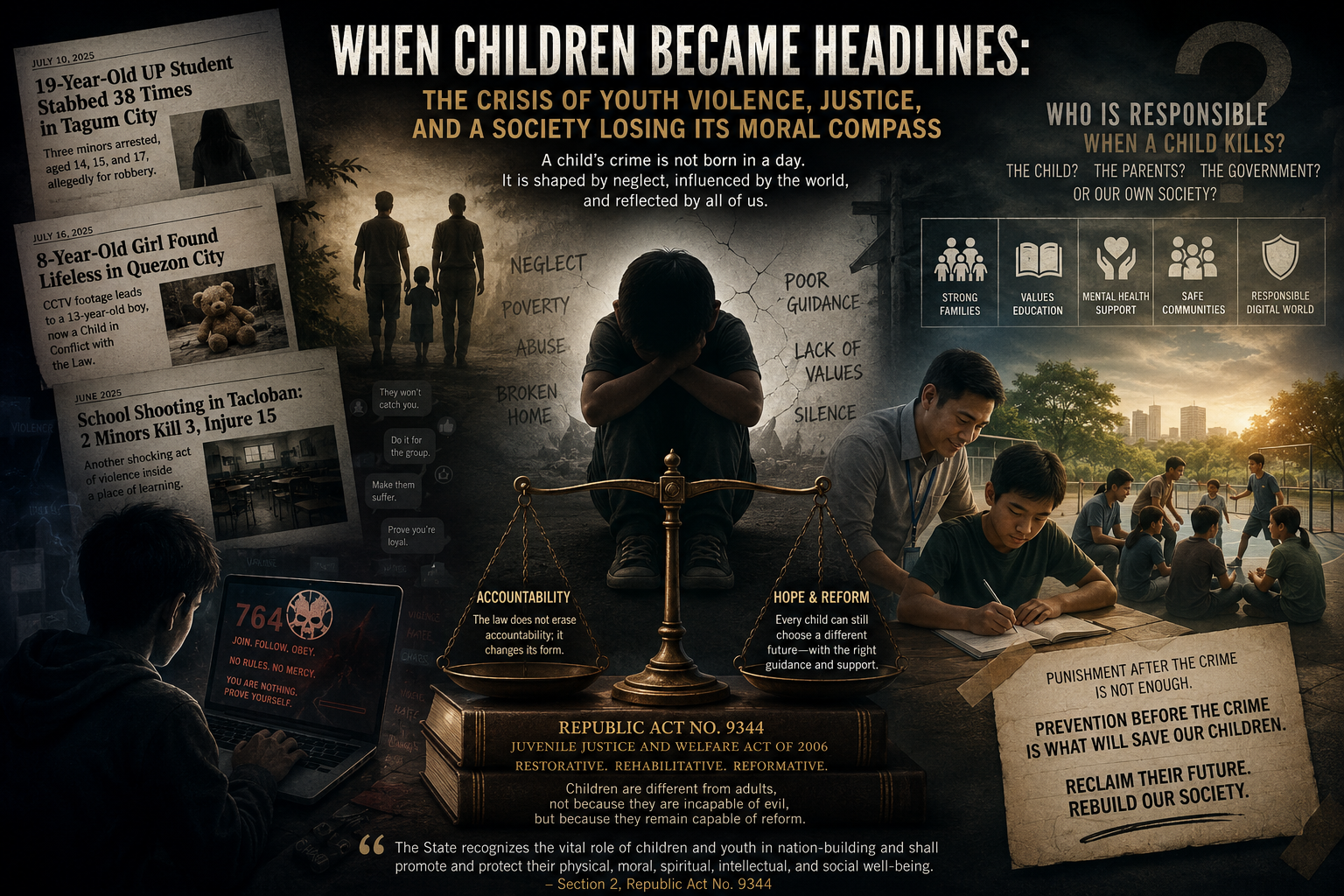
In July 2025, 19-year-old University of the Philippines student Sophia Marie Coquilla was found dead inside her bedroom in Tagum City,
bearing 38 stab wounds. Among those arrested were three minors—aged 14, 15, and 17—whose alleged motive was robbery. 1
Days later, an eight-year-old girl in Quezon City was found lifeless in a vacant lot. CCTV footage led authorities to a 13-year-old boy, now classified as a Child in Conflict with the Law. 2
Then came the unimaginable almost a year after. Inside a public high school in Tacloban City, two minors allegedly opened fire, killing three students and injuring fifteen others. 3
The headlines are becoming disturbingly familiar.
Children are no longer appearing only as victims of crime. Increasingly, they are the ones committing it.
That reality forces us to confront questions far deeper than whether Republic Act No. 9344 should be amended.
What becomes of a society when its children are capable of murder?
What kind of home, school, community, or digital world produces a fourteen-year-old who can stab another human being thirty-eight times?
When a child kills, whose failure are we really witnessing—the child’s, the parents’, the government’s, or our own?
The instinctive response is to demand harsher punishment. Every tragedy revives familiar calls to lower the minimum age of criminal responsibility. But punishment answers only one question: What do we do after the crime?
The debate, however, should not begin with calls to lower the age of criminal responsibility. It should begin with understanding the law that already exists.
The bedrock of juvenile justice in the Philippines is the Juvenile Justice and Welfare Act of 2006 (Republic Act No. 9344), later strengthened by Republic Act No. 10630. Contrary to popular belief, the law was never intended to excuse criminal behavior. It was designed to recognize a difficult truth: children are different from adults—not because they are incapable of doing evil, but because they remain capable of genuine reform.
Its philosophy is rooted not in leniency, but in restorative justice. As Section 2 of the law declares 4 :
“The State recognizes the vital role of children and youth in nation-building and shall promote and protect their physical, moral, spiritual, intellectual, and social well-being. It shall inculcate in the youth patriotism and nationalism, and encourage their involvement in public and civic affairs.”
That declaration is both hopeful and demanding. It places an enormous obligation on the State, the family, and society. If we believe children can still be saved, then we must also ask who is responsible when children could not be held liable?
Unfortunately, public discourse often begins from a misconception. Many Filipinos believe that minors are immune from punishment—that they can kill, steal, or rape without consequence simply because they are under eighteen.
That is false.
The law does not erase accountability; it changes its form.
Children aged fifteen and below are exempt from criminal liability but are required to undergo intervention programs. Those above fifteen but below eighteen are exempt only if they acted without discernment. If discernment is established, they are held accountable through a justice system tailored to their developmental stage—one that emphasizes diversion, psychological counseling, rehabilitation, education, and community service rather than automatic incarceration. 5
The law asks one crucial legal question: whether the child acted with discernment. These cases are not merely about criminal intent. They are also manifestations of years of moral neglect, inadequate guidance, and systemic failures that allowed children to reach such a point.
This is where the debate over RA 9344 becomes more complicated than slogans demanding “tougher laws.”
Former Chief Justice Artemio Panganiban observed that the framers of RA 9344 could never have anticipated the digital world children now inhabit.6 In 2006, Facebook had barely reached the Philippines. TikTok did not exist. Podcasts hosted by men with archaic and violent philosophies are not a thing. Recommendation algorithms did not shape a child’s worldview every waking hour. Extremist online communities capable of recruiting teenagers across continents were almost unimaginable.
Today, they are reality.
Reports surrounding the Tacloban school shooting alleged that the teenage perpetrators had been influenced by “764,” an online extremist network notorious for manipulating vulnerable minors into committing increasingly violent acts.7 Chief Justice Panganiban warned that the internet has fundamentally altered the environment in which children develop discernment, exposing them to radical influences that lawmakers in 2006 simply could not have foreseen. 8
If a child’s understanding of right and wrong can now be shaped by anonymous strangers thousands of miles away, can we honestly evaluate discernment the same way we did twenty years ago?
This digital reality has intensified calls to lower the minimum age of criminal responsibility to ten or twelve years old.
Supporters argue that criminal syndicates deliberately exploit the current law by recruiting children precisely because they know the justice system treats them differently. 9 If adults weaponize children as disposable shields, should the law continue to allow that loophole?
Yet child-rights advocates and neuroscientists urge restraint. Decades of research demonstrate that the adolescent brain—particularly the prefrontal cortex responsible for impulse control, judgment, and long-term decision-making—remains far from fully developed. 10 Their warning is equally compelling: imprisoning children earlier may satiate public anger, but it does little to prevent future crime. Instead, it risks producing more hardened criminals.
Both sides ask important questions, yet neither asks the most important one.
Why are so many children becoming susceptible to violence in the first place?
Violence does not emerge in a vacuum. It grows. It is learned. It is normalized.
Increasingly, that normalization is happening online. Perhaps, even reinforced by politicians draped in performative machoism, brandishing a distorted interpretation of the Übermensch as their manifesto.
Over the past decade, a sprawling ecosystem known as the “manosphere” has quietly spread across social media platforms. Disguised as content about fitness, discipline, confidence, or financial success, many of these communities gradually funnel lonely, misguided young boys toward “red pill” ideologies built on misogyny, dominance, biological determinism, and resentment. Vulnerable adolescents searching for identity are taught that empathy is weakness, aggression is masculinity, and women are adversaries rather than equals.
If social media has become one of the most influential teachers in a child’s life, should technology companies bear greater responsibility for the harm their recommendation systems amplify? Or does that responsibility ultimately belong to parents?
Public outrage has increasingly shifted toward families. Some argue that giving a child unrestricted access to the internet without supervision is no different from handing them the keys to a car without teaching them how to drive. If parents can be held responsible when their children cause physical harm, should they also bear responsibility when neglect allows online radicalization to flourish?
Yet that argument, too, ignores difficult realities.
How does an Overseas Filipino Worker monitor a teenager from thousands of miles away? How does a single mother working two jobs review every Discord server, gaming platform, and encrypted messaging app her child joins? How do parents compete against billion-dollar algorithms specifically engineered to capture and manipulate human attention?
Perhaps the failure is larger than any individual household.
Perhaps we have expected parents to fight a battle against technology with nothing but good intentions.
While Congress remains locked in debates over lowering the age of criminal responsibility, an even more uncomfortable truth receives far less attention.
We have failed to implement the law we already have.
Republic Act No. 10630 requires every province and highly urbanized city to establish a Bahay Pag-asa, a child-caring institution equipped with an Intensive Juvenile Intervention and Support Center for children who commit serious offenses. These are not supposed to be detention facilities. They are meant to be staffed by psychologists, social workers, doctors, counselors, and child welfare specialists capable of addressing the roots of juvenile offending. 11
Yet more than a decade later, those promises remain largely unfulfilled.
Only a fraction of provinces and highly urbanized cities have operational Bahay Pag-asa facilities. Even fewer possess valid accreditation from the Department of Social Welfare and Development. Executive Director Tricia Clare Oco of the Juvenile Justice and Welfare Council candidly acknowledged that many local government units simply prioritize other expenditures despite the law’s clear mandate. 12
Is it any wonder that rehabilitation appears ineffective when the institutions meant to deliver it barely exist?
Before demanding harsher penalties for children, perhaps government should first answer why it has failed to build the rehabilitation centers the law itself requires.
As Congress debates tougher punishments, other leaders caution against simplistic solutions: ban videogames. Senator Bam Aquino has argued that video games should not become convenient scapegoats for deeper social failures, advocating instead for stricter enforcement of age ratings and stronger parental digital literacy. 13 Meanwhile, discussions from Malacañang and Senate President Sherwin Gatchalian have explored tighter restrictions on minors’ access to social media, particularly to shield children from extremist communities like “764.” 14
The truth is uncomfortable because it refuses to fit neatly into politics.
Lowering the age of criminal responsibility will not rebuild broken homes.
It will not teach empathy.
It will not defeat criminal syndicates.
It will not dismantle extremist online networks.
It will not replace absent parents.
It will not build the Bahay Pag-asa facilities that government has neglected for over a decade.
The real crisis is not simply that children are committing crimes. It is that somewhere along the way, we have allowed too many children to grow up without enough moral anchors, emotional guidance, community support, or protection from digital predators.
Accountability and compassion are not opposing values. A civilized society must demand both.
Until families, schools, communities, technology companies, and government accept that responsibility together, the headlines will continue to remind us of a painful truth: We are not merely losing children to crime. We are losing childhood itself.
Days later, an eight-year-old girl in Quezon City was found lifeless in a vacant lot. CCTV footage led authorities to a 13-year-old boy, now classified as a Child in Conflict with the Law. 2
Then came the unimaginable almost a year after. Inside a public high school in Tacloban City, two minors allegedly opened fire, killing three students and injuring fifteen others. 3
The headlines are becoming disturbingly familiar.
Children are no longer appearing only as victims of crime. Increasingly, they are the ones committing it.
That reality forces us to confront questions far deeper than whether Republic Act No. 9344 should be amended.
What becomes of a society when its children are capable of murder?
What kind of home, school, community, or digital world produces a fourteen-year-old who can stab another human being thirty-eight times?
When a child kills, whose failure are we really witnessing—the child’s, the parents’, the government’s, or our own?
The instinctive response is to demand harsher punishment. Every tragedy revives familiar calls to lower the minimum age of criminal responsibility. But punishment answers only one question: What do we do after the crime?
The debate, however, should not begin with calls to lower the age of criminal responsibility. It should begin with understanding the law that already exists.
The bedrock of juvenile justice in the Philippines is the Juvenile Justice and Welfare Act of 2006 (Republic Act No. 9344), later strengthened by Republic Act No. 10630. Contrary to popular belief, the law was never intended to excuse criminal behavior. It was designed to recognize a difficult truth: children are different from adults—not because they are incapable of doing evil, but because they remain capable of genuine reform.
Its philosophy is rooted not in leniency, but in restorative justice. As Section 2 of the law declares 4 :
“The State recognizes the vital role of children and youth in nation-building and shall promote and protect their physical, moral, spiritual, intellectual, and social well-being. It shall inculcate in the youth patriotism and nationalism, and encourage their involvement in public and civic affairs.”
That declaration is both hopeful and demanding. It places an enormous obligation on the State, the family, and society. If we believe children can still be saved, then we must also ask who is responsible when children could not be held liable?
Unfortunately, public discourse often begins from a misconception. Many Filipinos believe that minors are immune from punishment—that they can kill, steal, or rape without consequence simply because they are under eighteen.
That is false.
The law does not erase accountability; it changes its form.
Children aged fifteen and below are exempt from criminal liability but are required to undergo intervention programs. Those above fifteen but below eighteen are exempt only if they acted without discernment. If discernment is established, they are held accountable through a justice system tailored to their developmental stage—one that emphasizes diversion, psychological counseling, rehabilitation, education, and community service rather than automatic incarceration. 5
The law asks one crucial legal question: whether the child acted with discernment. These cases are not merely about criminal intent. They are also manifestations of years of moral neglect, inadequate guidance, and systemic failures that allowed children to reach such a point.
This is where the debate over RA 9344 becomes more complicated than slogans demanding “tougher laws.”
Former Chief Justice Artemio Panganiban observed that the framers of RA 9344 could never have anticipated the digital world children now inhabit.6 In 2006, Facebook had barely reached the Philippines. TikTok did not exist. Podcasts hosted by men with archaic and violent philosophies are not a thing. Recommendation algorithms did not shape a child’s worldview every waking hour. Extremist online communities capable of recruiting teenagers across continents were almost unimaginable.
Today, they are reality.
Reports surrounding the Tacloban school shooting alleged that the teenage perpetrators had been influenced by “764,” an online extremist network notorious for manipulating vulnerable minors into committing increasingly violent acts.7 Chief Justice Panganiban warned that the internet has fundamentally altered the environment in which children develop discernment, exposing them to radical influences that lawmakers in 2006 simply could not have foreseen. 8
If a child’s understanding of right and wrong can now be shaped by anonymous strangers thousands of miles away, can we honestly evaluate discernment the same way we did twenty years ago?
This digital reality has intensified calls to lower the minimum age of criminal responsibility to ten or twelve years old.
Supporters argue that criminal syndicates deliberately exploit the current law by recruiting children precisely because they know the justice system treats them differently. 9 If adults weaponize children as disposable shields, should the law continue to allow that loophole?
Yet child-rights advocates and neuroscientists urge restraint. Decades of research demonstrate that the adolescent brain—particularly the prefrontal cortex responsible for impulse control, judgment, and long-term decision-making—remains far from fully developed. 10 Their warning is equally compelling: imprisoning children earlier may satiate public anger, but it does little to prevent future crime. Instead, it risks producing more hardened criminals.
Both sides ask important questions, yet neither asks the most important one.
Why are so many children becoming susceptible to violence in the first place?
Violence does not emerge in a vacuum. It grows. It is learned. It is normalized.
Increasingly, that normalization is happening online. Perhaps, even reinforced by politicians draped in performative machoism, brandishing a distorted interpretation of the Übermensch as their manifesto.
Over the past decade, a sprawling ecosystem known as the “manosphere” has quietly spread across social media platforms. Disguised as content about fitness, discipline, confidence, or financial success, many of these communities gradually funnel lonely, misguided young boys toward “red pill” ideologies built on misogyny, dominance, biological determinism, and resentment. Vulnerable adolescents searching for identity are taught that empathy is weakness, aggression is masculinity, and women are adversaries rather than equals.
If social media has become one of the most influential teachers in a child’s life, should technology companies bear greater responsibility for the harm their recommendation systems amplify? Or does that responsibility ultimately belong to parents?
Public outrage has increasingly shifted toward families. Some argue that giving a child unrestricted access to the internet without supervision is no different from handing them the keys to a car without teaching them how to drive. If parents can be held responsible when their children cause physical harm, should they also bear responsibility when neglect allows online radicalization to flourish?
Yet that argument, too, ignores difficult realities.
How does an Overseas Filipino Worker monitor a teenager from thousands of miles away? How does a single mother working two jobs review every Discord server, gaming platform, and encrypted messaging app her child joins? How do parents compete against billion-dollar algorithms specifically engineered to capture and manipulate human attention?
Perhaps the failure is larger than any individual household.
Perhaps we have expected parents to fight a battle against technology with nothing but good intentions.
While Congress remains locked in debates over lowering the age of criminal responsibility, an even more uncomfortable truth receives far less attention.
We have failed to implement the law we already have.
Republic Act No. 10630 requires every province and highly urbanized city to establish a Bahay Pag-asa, a child-caring institution equipped with an Intensive Juvenile Intervention and Support Center for children who commit serious offenses. These are not supposed to be detention facilities. They are meant to be staffed by psychologists, social workers, doctors, counselors, and child welfare specialists capable of addressing the roots of juvenile offending. 11
Yet more than a decade later, those promises remain largely unfulfilled.
Only a fraction of provinces and highly urbanized cities have operational Bahay Pag-asa facilities. Even fewer possess valid accreditation from the Department of Social Welfare and Development. Executive Director Tricia Clare Oco of the Juvenile Justice and Welfare Council candidly acknowledged that many local government units simply prioritize other expenditures despite the law’s clear mandate. 12
Is it any wonder that rehabilitation appears ineffective when the institutions meant to deliver it barely exist?
Before demanding harsher penalties for children, perhaps government should first answer why it has failed to build the rehabilitation centers the law itself requires.
As Congress debates tougher punishments, other leaders caution against simplistic solutions: ban videogames. Senator Bam Aquino has argued that video games should not become convenient scapegoats for deeper social failures, advocating instead for stricter enforcement of age ratings and stronger parental digital literacy. 13 Meanwhile, discussions from Malacañang and Senate President Sherwin Gatchalian have explored tighter restrictions on minors’ access to social media, particularly to shield children from extremist communities like “764.” 14
The truth is uncomfortable because it refuses to fit neatly into politics.
Lowering the age of criminal responsibility will not rebuild broken homes.
It will not teach empathy.
It will not defeat criminal syndicates.
It will not dismantle extremist online networks.
It will not replace absent parents.
It will not build the Bahay Pag-asa facilities that government has neglected for over a decade.
The real crisis is not simply that children are committing crimes. It is that somewhere along the way, we have allowed too many children to grow up without enough moral anchors, emotional guidance, community support, or protection from digital predators.
Accountability and compassion are not opposing values. A civilized society must demand both.
Until families, schools, communities, technology companies, and government accept that responsibility together, the headlines will continue to remind us of a painful truth: We are not merely losing children to crime. We are losing childhood itself.
FOOTNOTES
1. Lagsa, B. (2025, July 18). Outrage, grief pour out over murder of young Davao campus journalist Sophia Coquilla. Rappler. https://www.rappler.com/philippines/mindanao/reactions-campus-journalist-sophia-coquilla-murder/
2. Argosino, F. (2025, August 4). 8-year-old girl found dead in a vacant lot in QC – police. INQUIRER.net. https://newsinfo.inquirer.net/2091505/8-year-old-girl-found-dead-in-a-vacant-lot-in-qc-police
3. Gabieta, J. A. (2026, June 22). School shooting kills 3 students in Tacloban. INQUIRER.net. https://newsinfo.inquirer.net/2250793/school-shooting-kills-3-students-in-tacloban
6. Politiko. (2026, July 6). Panganiban: Juvenile Justice Law framers did not anticipate tech, social media impact on kids. Politiko Lokal. https://politiko.com.ph/2026/07/06/panganiban-juvenile-justice-law-framers-did-not-anticipate-tech-social-media-impact-on-kids/politiko-lokal/
7. Rappler. (2026, July 1). Tacloban school shooting sparks fears of online violent extremism grooming kids. Rappler. https://www.rappler.com/technology/tacloban-school-shooting-fears-online-violent-extremism/
9. Flores, H. (2026, July 6). Marcos: Lower age of criminal liability needs study. OneNews.PH.
https://www.onenews.ph/marcos-lower-age-of-criminal-liability-needs-study
https://www.onenews.ph/marcos-lower-age-of-criminal-liability-needs-study
10. Psychological Association of the Philippines. (2016, August 24). On the amendment to the Juvenile Justice and Welfare Act [Position paper].
https://pap.ph/position-paper/16
https://pap.ph/position-paper/16
11. Ronquillo, A., & Mateo, J. (2026, July 6). Lack of facilities shows gaps in juvenile justice system. Philstar.com.
https://www.philstar.com/headlines/2026/07/06/2540119/lack-facilities-shows-gaps-juvenile-justice-system
13. Clores, K. (2026, June 29). Video games ‘convenient scapegoat’ for school violence, says Bam Aquino. INQUIRER.net. https://newsinfo.inquirer.net/2254441/fwd-games-convenient-scapegoat-for-school-violence-aquino
14. Magsambol, B. (2026, June 28). Gatchalian to push social media curbs for minors. INQUIRER.net. https://newsinfo.inquirer.net/2254318/gatchalian-to-push-social-media-curbs-for-minors
*The views and opinions expressed are based on applicable laws, constitutional provisions, and/or jurisprudence in force at the time of writing, and do not constitute legal advice or an official stance on any political matter. Subsequent legal or factual developments may affect the relevance or applicability of the views and opinions herein expressed.