
When Legal Problems Arise in the Realm of Healthcare: Understanding Philippine Laws Geared towards Medical Malpractice
Atty Katrina Isabelle T. Tugas
Atty Lea Mona P. Chu
Atty. Rhenelle Mae O. Operario.
MAY 2026
After undergoing a series of diagnostic procedures, including a transvaginal ultrasound, saline sonohysterography, and
hysteroscopy, Maria was diagnosed by Dr. Angel with uterine polyps—an abnormal tissue growth within the uterine cavity. To address the condition,
Dr. Angel recommended that Maria undergo a polypectomy, assuring her that the procedure was routinely performed. Trusting in the competence and
expertise of her physician, Maria consented to the operation, which was conducted at the hospital where Dr. Angel practiced, with her serving as
the attending physician and principal surgeon. Maria entered the operating room expecting nothing more than a safe and straightforward procedure
that would finally bring relief to her condition. Instead, what was supposed to be a routine medical intervention turned into a harrowing ordeal.
Despite the minimally invasive nature of the procedure, Maria suffered a rupture of an internal organ—an injury that transformed an otherwise
ordinary operation into a life-threatening medical emergency.
One day post-discharge, Maria was readmitted on an emergency basis after exhibiting concerning clinical signs, including the extrusion of partially digested food material, with rice-like particulates, from the surgical wound site. To this date, Maria remains hospitalized, continuously incurring mounting medical expenses, enduring pain, emotional distress, and facing the real risk of further life-threatening complications.
Given the serious injuries and complications suffered by Maria following what was supposed to be a routine and minimally invasive procedure, the question now arises as to the legal remedies available to her against Dr. Angel and the hospital for the alleged medical negligence and the damages she continues to endure.
In De Jesus vs. Dr. Uyloan 1, a decision penned by Chief Justice Gesmundo, the Supreme Court defined Medical Malpractice, thus:
One day post-discharge, Maria was readmitted on an emergency basis after exhibiting concerning clinical signs, including the extrusion of partially digested food material, with rice-like particulates, from the surgical wound site. To this date, Maria remains hospitalized, continuously incurring mounting medical expenses, enduring pain, emotional distress, and facing the real risk of further life-threatening complications.
Given the serious injuries and complications suffered by Maria following what was supposed to be a routine and minimally invasive procedure, the question now arises as to the legal remedies available to her against Dr. Angel and the hospital for the alleged medical negligence and the damages she continues to endure.
In De Jesus vs. Dr. Uyloan 1, a decision penned by Chief Justice Gesmundo, the Supreme Court defined Medical Malpractice, thus:
“When a patient engages the services of a physician, a physician-patient relationship is generated. The type of lawsuit which has
been called medical malpractice or, more appropriately, medical negligence, is that type of claim which a victim (patient) has
available to him or her to redress a wrong committed by a medical professional which has caused bodily harm.”
First, a victim of medical malpractice may file a civil action to recover damages for the injury he has suffered anchored on the alleged violation of Art. 2176 of the Civil Code, which states that:
ART. 2176. Whoever by act or omission causes damage to another, there being fault or negligence, is obliged to pay for
the damage done. Such fault or negligence, if there is no pre-existing contractual relation between the parties, is called a
quasi-delict and is governed by the provisions of this Chapter.
In litigations involving medical negligence as in any civil action, the burden to prove by preponderance of evidence the essential elements – i.e., duty, breach, injury and proximate causation – rests with Maria. 2
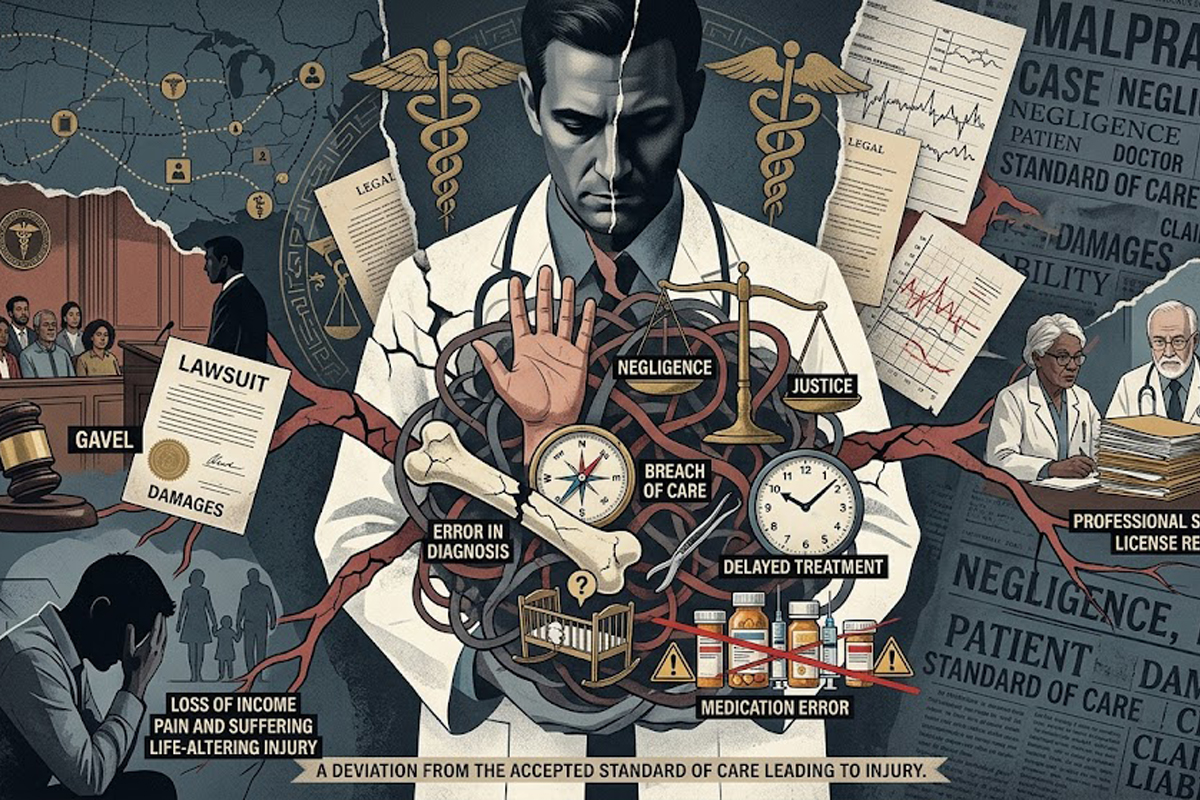
Once a physician–patient relationship is established, a legal duty of care arises. The physician must exercise the standard of care expected of a reasonably competent doctor under similar circumstances. A breach occurs when this standard is not met, and if it results in injury to the patient’s health or body, it constitutes medical malpractice, giving rise to a claim for damages. 3
Second, Article 365 of the Revised Penal Code, allows criminal prosecution for negligent physicians, but conviction requires proof beyond reasonable doubt. This standard is harder to meet, so evidence sufficient for civil liability is often not enough for criminal conviction.
Lastly, a victim of medical malpractice may file a sworn complaint with the Professional Regulation Commission. After investigation, the Board of Medical Examiners may reprimand, suspend, or revoke a physician’s license for gross negligence, incompetence, or ethical violations that result in injury or death.
As to evidentiary requirements in criminal and civil cases, the Supreme Court has held that as a general rule, expert medical testimony is relied upon to prove that a physician has done a negligent act or that he has deviated from the standard medical procedure. 4 Solidum vs. People of the Philippines 5 provides an exception. There, it was explained that an expert testimony may be dispensed with when the application of the principle of res ipsa loquitur is warranted, contemplating a situation where the injury itself provides the proof of negligence or when the matters involved are within the common knowledge of mankind which may be testified to by anyone familiar with the facts.
Resort to the doctrine of res ipsa loquitur as an exception to the requirement of an expert testimony in medical negligence cases may be availed of if the following essential requisites are satisfied: (1) the accident was of a kind that does not ordinarily occur unless someone is negligent; (2) the instrumentality or agency that caused the injury was under the exclusive control of the person charged; and (3) the injury suffered must not have been due to any voluntary action or contribution of the person injured. This doctrine has been applied in the following cases involving medical practitioners: 6
a. Where a patient who was scheduled for a cholecystectomy (removal of gall stones) but was otherwise healthy suffered irreparable brain damage after being administered anesthesia prior to the operation; 7
b. Where after giving birth, a woman woke up with a gaping burn wound close to her left armpit; 8
c. The removal of the wrong body part during the operation; and
d. Where an operating surgeon left a foreign object (i.e., rubber gloves) inside the body of the patient. 9
As such, the rule of res ipsa loquitur comes to the fore in the case of Maria. The entire proceedings of the polypectomy were under the exclusive control of Dr. Angel. In this regard, although Maria was bereft of direct evidence identifying the precise agent or the definitive cause of the rupture of her internal organ that resulted in the discharge of rice-like particulate matter from the operative wound site, such an occurrence is not ordinarily encountered in the absence of medical negligence. Considering that Maria underwent no other surgical intervention apart from the polypectomy that could have precipitated the rupture of her internal organ, it is legally and medically reasonable to infer that the injury was a complication arising from the polypectomy performed by Dr. Angel.
In practice, establishing liability in medical malpractice cases—and tracing all the consequential harm that flows from it—presents a formidable and often arduous challenge. The difficulty is further compounded by the absence of a singular, comprehensive statute that consolidates the relevant provisions dispersed across various laws, as well as the absence of a unified legal framework that systematically gathers and codifies the doctrines developed through jurisprudence specifically governing medical malpractice.
It bears emphasis that the medical profession stands at the very heart of public health and welfare, entrusted with nothing less than the preservation of human life itself. In recognition of this profound responsibility, the State has a compelling interest in enacting measures that shield the public from the potentially devastating consequences of incompetence or lack of proficiency among those to whom the care of human health and life is entrusted. In this delicate balance between trust and expertise, even a single lapse in medical judgment or skill may spell the difference between survival and death for a patient whose life rests in a physician’s hands.
Against this backdrop, there arises a pressing need for comprehensive and meaningful reform in medical malpractice laws—one that strengthens and reaffirms the duties owed by physicians to their patients, and ensures that the highest standards of care are not merely aspirational, but firmly upheld in practice.
Once a physician–patient relationship is established, a legal duty of care arises. The physician must exercise the standard of care expected of a reasonably competent doctor under similar circumstances. A breach occurs when this standard is not met, and if it results in injury to the patient’s health or body, it constitutes medical malpractice, giving rise to a claim for damages. 3
Second, Article 365 of the Revised Penal Code, allows criminal prosecution for negligent physicians, but conviction requires proof beyond reasonable doubt. This standard is harder to meet, so evidence sufficient for civil liability is often not enough for criminal conviction.
Lastly, a victim of medical malpractice may file a sworn complaint with the Professional Regulation Commission. After investigation, the Board of Medical Examiners may reprimand, suspend, or revoke a physician’s license for gross negligence, incompetence, or ethical violations that result in injury or death.
As to evidentiary requirements in criminal and civil cases, the Supreme Court has held that as a general rule, expert medical testimony is relied upon to prove that a physician has done a negligent act or that he has deviated from the standard medical procedure. 4 Solidum vs. People of the Philippines 5 provides an exception. There, it was explained that an expert testimony may be dispensed with when the application of the principle of res ipsa loquitur is warranted, contemplating a situation where the injury itself provides the proof of negligence or when the matters involved are within the common knowledge of mankind which may be testified to by anyone familiar with the facts.
Resort to the doctrine of res ipsa loquitur as an exception to the requirement of an expert testimony in medical negligence cases may be availed of if the following essential requisites are satisfied: (1) the accident was of a kind that does not ordinarily occur unless someone is negligent; (2) the instrumentality or agency that caused the injury was under the exclusive control of the person charged; and (3) the injury suffered must not have been due to any voluntary action or contribution of the person injured. This doctrine has been applied in the following cases involving medical practitioners: 6
a. Where a patient who was scheduled for a cholecystectomy (removal of gall stones) but was otherwise healthy suffered irreparable brain damage after being administered anesthesia prior to the operation; 7
b. Where after giving birth, a woman woke up with a gaping burn wound close to her left armpit; 8
c. The removal of the wrong body part during the operation; and
d. Where an operating surgeon left a foreign object (i.e., rubber gloves) inside the body of the patient. 9
As such, the rule of res ipsa loquitur comes to the fore in the case of Maria. The entire proceedings of the polypectomy were under the exclusive control of Dr. Angel. In this regard, although Maria was bereft of direct evidence identifying the precise agent or the definitive cause of the rupture of her internal organ that resulted in the discharge of rice-like particulate matter from the operative wound site, such an occurrence is not ordinarily encountered in the absence of medical negligence. Considering that Maria underwent no other surgical intervention apart from the polypectomy that could have precipitated the rupture of her internal organ, it is legally and medically reasonable to infer that the injury was a complication arising from the polypectomy performed by Dr. Angel.
In practice, establishing liability in medical malpractice cases—and tracing all the consequential harm that flows from it—presents a formidable and often arduous challenge. The difficulty is further compounded by the absence of a singular, comprehensive statute that consolidates the relevant provisions dispersed across various laws, as well as the absence of a unified legal framework that systematically gathers and codifies the doctrines developed through jurisprudence specifically governing medical malpractice.
It bears emphasis that the medical profession stands at the very heart of public health and welfare, entrusted with nothing less than the preservation of human life itself. In recognition of this profound responsibility, the State has a compelling interest in enacting measures that shield the public from the potentially devastating consequences of incompetence or lack of proficiency among those to whom the care of human health and life is entrusted. In this delicate balance between trust and expertise, even a single lapse in medical judgment or skill may spell the difference between survival and death for a patient whose life rests in a physician’s hands.
Against this backdrop, there arises a pressing need for comprehensive and meaningful reform in medical malpractice laws—one that strengthens and reaffirms the duties owed by physicians to their patients, and ensures that the highest standards of care are not merely aspirational, but firmly upheld in practice.
DISCLAIMER: The scenario presented is entirely fictional and is not based on real persons, events, or cases. Any resemblance or connection, whether direct or indirect, to actual persons, events, or cases is purely coincidental..