Beyond Cameras and Traffic Enforcers: From Restraint to Reimplementation of the No Contact Apprehension Policy
Immanuel Christian V. Fontanilla
Atty. Rhenelle Mae O. Operario
OCTOBER 2026
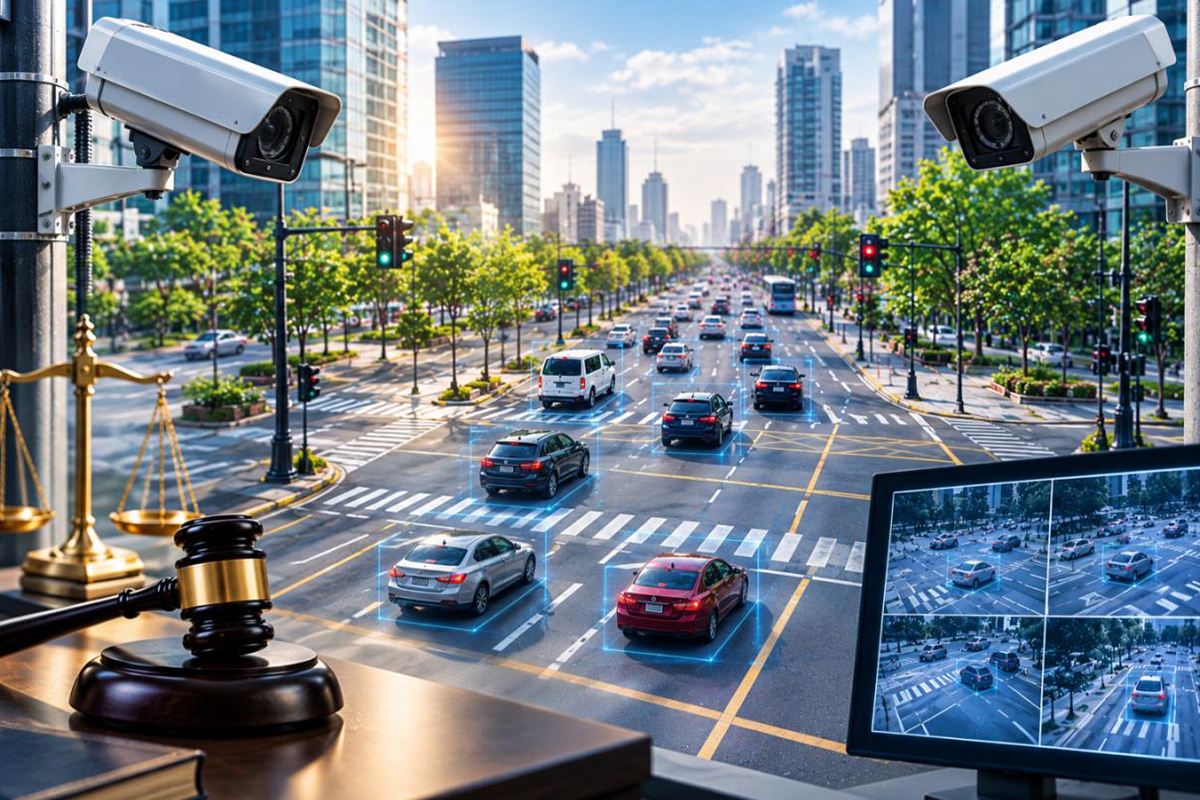
In 2002, however, the MMDA only proposed the “No Physical Contact Policy” which merely utilized digital cameras in the apprehension of traffic violators essentially preventing traffic build up caused by apprehended violators. Eventually, due to recent developments in modern technology, particularly Closed-Circuit Television Cameras (CCTV), the NCAP was eventually reinstated on 16 February 2026 through MMDA Resolution No. 16-01 series of 2016 in an attempt to lessen traffic congestion by the stoppage of traffic violators on major thoroughfares.
One might ask, how does the NCAP actually work? To put it simply:
While its implementation thereof may appear straightforward, its practical application seems to be far more complex. Legal questions arise as to whether or not the technological advancement utilized by NCAP can effectively substitute the tried and tested traffic enforcement we have both come to love and hate.
It must be remembered that on 30 August 2022, the Honorable Supreme Court issued a Temporary Restraining Order (TRO) which effectively suspended the implementation of the NCAP in response to petitions that were filed by different transport groups and motorists.2
One notable petition which prompted the Honorable Supreme Court to meddle in the implementation of the NCAP was made by a lawyer who was refused vehicle registration renewal by the Land Transportation Office (LTO) when it was found that he has an unpaid fine of around Twenty Thousand Pesos (Php 20,000.00) wherein he claimed that he never received any prior notice thereto.3
The aforementioned TRO was initially lifted in May 2025 for roads which were under the jurisdiction of the MMDA in an effort to ease severe vehicular congestion along major thoroughfares. Eventually, the NCAP was reimplemented beginning 05 October 2026 across six (6) cities in Metro Manila, namely, the Cities of Manila, Muntinlupa, Paranaque, Quezon City, San Juan and Valenzuela.
Now, the Honorable Supreme Court ultimately decided on the aforementioned Petitions that were filed questioning the constitutionality and validity of the NCAP in the case of Kilusan sa Pagbabago ng Industriya ng Transportasyon, Inc., (KAPIT), et. al., vs. City of Manila (G.R. No. 261892, 262192, and 263752, 03 June 2026) 4.
The parties of the abovementioned case assailed the legality of the NCAP being implemented by the MMDA and the City of Manila for being in direct contravention with Republic Act No. 4136 or the Land and Transportation and Traffic Code which contemplates face-to-face apprehension and imposing liability on the erring driver, not registered owners.
Another point of contention raised was that the NCAP violates due process whereby motorists were immediately imposed penalties without proper notice nor opportunity to contest the said violation coupled by that these penalties are accompanied by accumulated fines without even proper prior notice.
An exhaustive and lengthy discussion was laid down by the Honorable Supreme Court relative to assailed NCAP Ordinances, and by extension, the Metro Manila Traffic Code that was enacted in 2023.
As to the issue for Grave violation of the Constitution, the Honorable Supreme Court held that the superseding ordinances and MMTC are not matters presently before the court and to rule on its constitutionality would be tantamount to passing judgment on a legal instrument which had not been properly challenged, to quote:
It must be noted however that the dismissal thereof was grounded upon the failure of the Petitioners to overcome threshold issues and the subsequent adoption of a uniform regulatory framework (MMTC) which ultimately left the Honorable Supreme Court with no substantial issue left to decide on, to quote:
“We deem it necessary to emphasize, especially for the general public, that Our dismissal of the Petitions should not be taken to mean that the challenged framework is valid. Our dismissal of the Petitions is confined to the determination that petitioners failed to overcome threshold issues, and that the supervening adoption of a uniform regulatory framework has rendered the Petitions moot.” 6
This pronouncement must not be taken on its face-value and focus only on the dismissal of the Petition. It must also be taken into consideration that the real objective of the MMDA in enacting the NCAP cannot, on its own, go beyond the limits in what is provided under our laws as to do so would be tantamount to a blatant violation of our Constitution.
It bears emphasis that the State is still bound by the rules of the Constitution particularly as to the exercise of “Police Power” or the “inherent power of the State to promote public welfare by restraining and regulating the use of liberty and property.” 8
In simpler terms, it is the power granted to the state in order to uphold rules and regulations necessary to maintain peace in our society, otherwise, this may lead the country to disarray and chaos.
Now, how does the dismissal of the Petition affect motorists considering that the NCAP is very well active across the six (6) aforementioned cities?
As of the moment, motorists remain subjected to the applicable traffic laws and regulations within the scope of NCAP. Strict compliance with these rules remain necessary, and violations thereof shall give rise to corresponding administrative penalties and sanctions under the MMTC. The continued implementation of the NCAP, following the Court’s disposition in the afore-cited case, severely underscores the importance of properly understanding and assessment of the legal consequences accompanying such implementation.
The NCAP should be examined not merely as an automated mechanism for detecting traffic regulations but as a regulatory system composed of several distinct matters. For motorists, the significance of the NCAP extends beyond the simple obligation to observe traffic rules but to call for appreciation on the legal framework which properly governs how a traffic violation is detected, a vehicle owner is identified, how personal information is processed and shared between government agencies, and how liability and penalties are ultimately imposed by the State.
It bears emphasis that strict compliance with traffic laws and regulations remains a necessary and integral responsibility for every motorist. Such responsibility, however, must operate within a legal system/framework that is equally bound by due process, compliance with privacy laws and ultimately, the Constitution.
As the NCAP continues to form part of the State’s continually evolving traffic enforcement framework, its effectiveness should not be measured solely in its capacity to promote traffic discipline and road safety. It is equally important that there is a faithful adherence to the safeguard put in place by our Constitution which protects every motorist that is the subject of the NCAP.
Accordingly, ensuring compliance with the law is not the end goal to be considered as an effective traffic enforcement scheme but it is to ensure that the said compliance must only be within the heaps and bounds of our laws enshrined in our constitution.
FOOTNOTES
*The views and opinions expressed are based on applicable laws, constitutional provisions, and/or jurisprudence in force at the time of writing, and do not constitute legal advice or an official stance on any political matter. Subsequent legal or factual developments may affect the relevance or applicability of the views and opinions herein expressed.