
No Injunction Against a Worker's Daily Bread: Why the Temporary Restraining Order on the Minimum Wage Hike Defies the Law
Atty. Shiba Ashley Fernandez
Atty. Lea Mona Chu
Atty. Rhenelle Mae Operario
AUGUST 2026
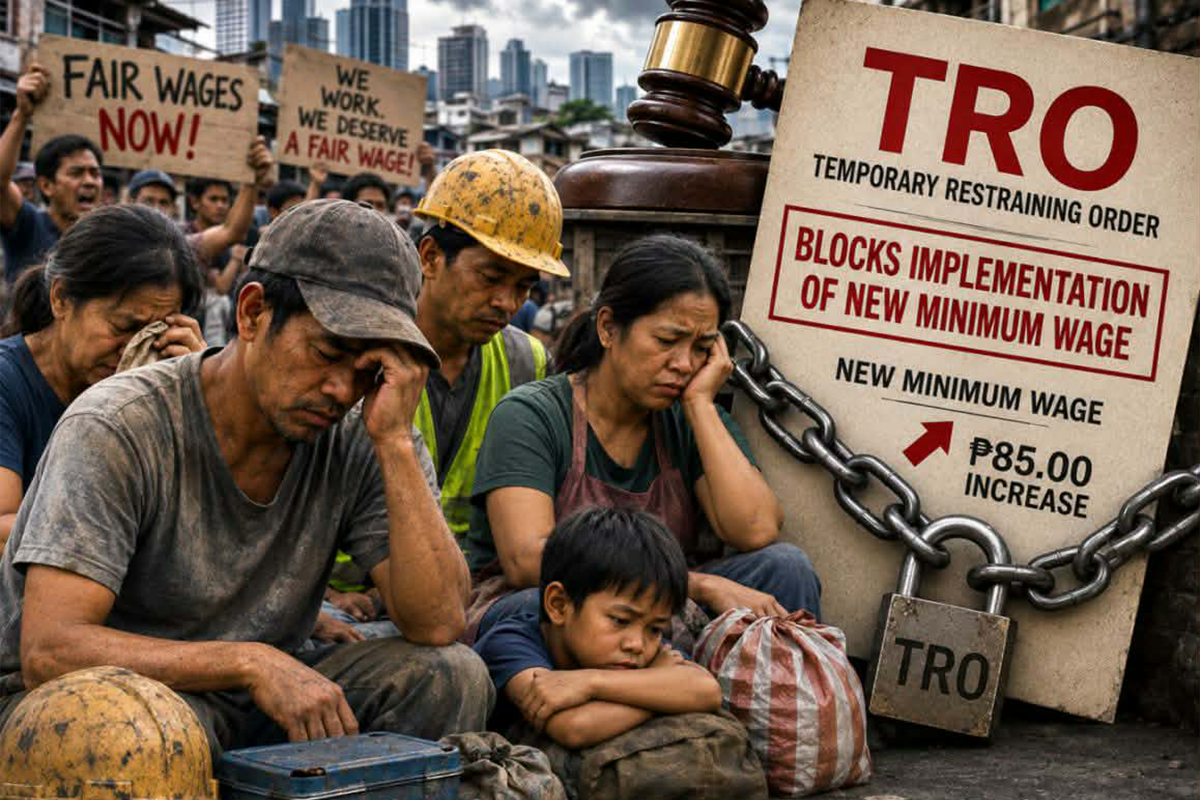
As the prices of basic commodities, fuel, and essential services continue to soar, minimum wage earners are left struggling to survive on
a daily wage of just Php 695.00 in the non-agricultural sector and Php 658.00 in the agricultural sector in Metro Manila.
From food on the table to transportation, rent, utilities, and medicine, these meager wages are expected to stretch across every basic necessity. But in the face of today’s relentless cost of living, they simply do not. For millions of workers, every payday is not a step toward stability; it is a desperate exercise in deciding which essential need must be sacrificed.
In response to the worsening financial plight of workers brought about by the relentless increase in the cost of living, various labor groups and workers’ associations filed separate wage petitions before the Regional Tripartite Wages and Productivity Board–National Capital Region (RTWPB–NCR), seeking a substantial increase in the daily minimum wage.
After due notice, consultation, and deliberation, the RTWPB–NCR found merit in the petitions and issued Wage Order No. NCR-27, granting an Php 85.00 increase in the daily minimum wage. Recognizing the need to balance the welfare of workers with the capacity of employers to comply, the increase shall be implemented in two tranches, as provided under Section 2 of Wage Order No. NCR-27 1, to wit:
From food on the table to transportation, rent, utilities, and medicine, these meager wages are expected to stretch across every basic necessity. But in the face of today’s relentless cost of living, they simply do not. For millions of workers, every payday is not a step toward stability; it is a desperate exercise in deciding which essential need must be sacrificed.
In response to the worsening financial plight of workers brought about by the relentless increase in the cost of living, various labor groups and workers’ associations filed separate wage petitions before the Regional Tripartite Wages and Productivity Board–National Capital Region (RTWPB–NCR), seeking a substantial increase in the daily minimum wage.
After due notice, consultation, and deliberation, the RTWPB–NCR found merit in the petitions and issued Wage Order No. NCR-27, granting an Php 85.00 increase in the daily minimum wage. Recognizing the need to balance the welfare of workers with the capacity of employers to comply, the increase shall be implemented in two tranches, as provided under Section 2 of Wage Order No. NCR-27 1, to wit:
Section 2. New Minimum Wage Rates. The new daily minimum wage rates in NCR shall be as follows:
| Sectors / Industry | Current Minimum Wage Rates | Amount of Increase | New Minimum Wage Rates | Amount of Increase | New Minimum Wage Rates |
| 1st Tranche | 2nd Tranche | ||||
| Upon Effectivity | January 20, 2027 | ||||
| Non - Agriculture | ₱ 695.00 | ₱ 60.00 | ₱ 755.00 | ₱ 25.00 | ₱ 780.00 |
| Agriculture (Plantation and Non-Plantation) | ₱ 658.00 | ₱ 60.00 | ₱ 718.00 | ₱ 25.00 | ₱ 743.00 |
| Service / Retail Establishment employing 15 worker or less | |||||
| Manufacturing regularly employing less that 10 workers | |||||
However, just as workers were about to receive much-needed relief, the implementation of the new minimum wage was put on hold by virtue of a Temporary Restraining Order (“TRO”)
issued by Judge Manongsong of the Regional Trial Court, Branch 152, Pasig City, effectively stopping the implementation of the new minimum wage rates in the NCR. The TRO was
issued upon the petition of Readycon Trading and Construction Corporation and R-II Builders, Inc. (“Petitioners”), which claimed that the implementation of the initial
Php 60.00 wage increase would result in higher labor costs, thus:
“Readycon President Jesus Ignacio argued that the initial P60 increase would significantly raise the construction company’s labor costs, which had already been factored into bids for existing projects.
He estimated an additional payroll expense of about P409,000, aside from higher mandatory contributions, benefits, salary adjustment for employees earning above minimum wage. 2”
He estimated an additional payroll expense of about P409,000, aside from higher mandatory contributions, benefits, salary adjustment for employees earning above minimum wage. 2”
Notably, in granting the TRO, the trial court ruled that the “immediate implementation of the wage order would cause ‘grave and irreparable injury’ to the petitioners, extending beyond
financial costs to possible workforce reductions and operational changes.” 3
Devastated by such news, BPO Industry Employees Network (BIEN) has expressed their deep disappointment over the suspension of the approved minimum wage increase, emphasizing that the wage hike was a long-overdue measure to help workers cope with the rising cost of living, to quote:
Devastated by such news, BPO Industry Employees Network (BIEN) has expressed their deep disappointment over the suspension of the approved minimum wage increase, emphasizing that the wage hike was a long-overdue measure to help workers cope with the rising cost of living, to quote:
“This legal maneuver is nothing more than another attempt by big business to deny workers even the smallest relief from the worsening cost of living.
The PHP85 wage increase, with only the first PHP60 tranche taking effect this July and the remaining PHP25 delayed until next year, is already far below . what workers and their families need to survive. Prices of food, transportation, housing, electricity, fuel, and other basic necessities continue to rise while wages remain trapped at poverty levels. Yet instead of recognizing the sacrifice of workers who create their profits every day, these employers want to take away even this measly increase.” 4
The PHP85 wage increase, with only the first PHP60 tranche taking effect this July and the remaining PHP25 delayed until next year, is already far below . what workers and their families need to survive. Prices of food, transportation, housing, electricity, fuel, and other basic necessities continue to rise while wages remain trapped at poverty levels. Yet instead of recognizing the sacrifice of workers who create their profits every day, these employers want to take away even this measly increase.” 4
Following the issuance of the TRO, the Department of Labor and Employment (DOLE), various labor groups, and several senators called for its immediate
lifting, asserting that no court has the authority to stop the implementation of a duly issued wage order. They emphasized that the TRO unjustly
delays the wage increase intended to provide much-needed relief to minimum wage earners.
Hence, it is imperative to revisit the laws that safeguard every worker’s right to a living wage. Foremost among these is Section 3, Article XIII of the 1987 Constitution, which mandates the State to afford full protection to labor and guarantees workers the right to receive a living wage.
Article 123 of the Labor Code authorizes the RTWPB to issue a wage order whenever conditions warrant. Before doing so, the RTWPB must conduct public hearings and consultations and notify employees’ and employers’ groups, local government officials, and other interested parties. These requirements were complied with by the RTWPB–NCR before it issued Wage Order No. NCR-27. While Art. 126 of the Labor Code, as amended by R.A. 6727, expressly provides that no injunction or temporary restraining order may be issued by any court, tribunal or other entity against any proceedings before the Commission or the Regional Boards.”
Here, the issuance of Wage Order No. NCR-27 was not arbitrary; it was the product of the wage-fixing process mandated by law, undertaken by the RTWPB after the required hearings and consultations. As such, the Wage Order was issued in accordance with the law; there is no reason why its implementation should be hindered. By halting its implementation, the TRO runs contrary to Article 124 of the Labor Code and frustrates the State’s constitutional duty to advance every worker’s right to a living wage.
Upon the effectivity of Wage Order No. 27-NCR, minimum wage earners acquired a vested right to the additional Php 60.00 wage increase because no Temporary Restraining Order (TRO) had yet been issued. Thus, workers who had already received the increase were entitled to keep it. As Secretary Tolentino clarified, employees are not required to return the additional amount, and employers cannot require them to refund the wage differential. He stated:
Hence, it is imperative to revisit the laws that safeguard every worker’s right to a living wage. Foremost among these is Section 3, Article XIII of the 1987 Constitution, which mandates the State to afford full protection to labor and guarantees workers the right to receive a living wage.
Article 123 of the Labor Code authorizes the RTWPB to issue a wage order whenever conditions warrant. Before doing so, the RTWPB must conduct public hearings and consultations and notify employees’ and employers’ groups, local government officials, and other interested parties. These requirements were complied with by the RTWPB–NCR before it issued Wage Order No. NCR-27. While Art. 126 of the Labor Code, as amended by R.A. 6727, expressly provides that no injunction or temporary restraining order may be issued by any court, tribunal or other entity against any proceedings before the Commission or the Regional Boards.”
Here, the issuance of Wage Order No. NCR-27 was not arbitrary; it was the product of the wage-fixing process mandated by law, undertaken by the RTWPB after the required hearings and consultations. As such, the Wage Order was issued in accordance with the law; there is no reason why its implementation should be hindered. By halting its implementation, the TRO runs contrary to Article 124 of the Labor Code and frustrates the State’s constitutional duty to advance every worker’s right to a living wage.
Upon the effectivity of Wage Order No. 27-NCR, minimum wage earners acquired a vested right to the additional Php 60.00 wage increase because no Temporary Restraining Order (TRO) had yet been issued. Thus, workers who had already received the increase were entitled to keep it. As Secretary Tolentino clarified, employees are not required to return the additional amount, and employers cannot require them to refund the wage differential. He stated:
“Meron nang vested right ‘yung manggawa no’n. Hindi na dapat isauli ‘yon…kasi at that time it was prepared, and at that time it was received,
wala pang order ‘yung National Wages and Productivity Commission na suspended,
The Secretary also emphasized that employers cannot ask workers to return the differential or execute wage deductions in subsequent payroll cycles.” 5
The Secretary also emphasized that employers cannot ask workers to return the differential or execute wage deductions in subsequent payroll cycles.” 5
While the 1987 Constitution and the Labor Code recognize the rights of employers, these rights should not be used to deprive workers of
benefits already granted by law. Labor laws exist to protect workers, who are generally in a weaker position than employers. Although
Petitioners claim that the wage increase will raise labor costs and reduce profits, these concerns cannot justify delaying a lawfully
approved wage increase that millions of workers urgently need. The economic interests of a few cannot outweigh the
fundamental right of workers to receive wages that allow them to live with dignity.
Indeed, the present minimum wage is no longer sufficient to meet basic daily needs, as the rising costs of food, fuel, transportation, utilities, and other essentials continue to erode workers’ purchasing power; every increase in fuel prices triggers a corresponding increase in the cost of basic commodities and services, leaving workers to bear the heaviest burden. For countless Filipino families, the approved wage increase is not a luxury—it is a lifeline.
Simply put, the Php 85.00 increase in the daily minimum wage is a small amount for employers, but it means so much to minimum wage earners. For employers, it may be an additional business expense. For workers, it could mean enough money for food, transportation, medicine, or other basic necessities. They make ends meet with what little they earn, and every peso counts. The approved wage increase may be modest, but it provides much-needed relief to workers and their families.
Ultimately, this case is not just about Php 85.00. It is about upholding the law and protecting the constitutional right of every worker to a living wage. A wage increase that has been lawfully determined after the process required by the Labor Code should not be denied to the very workers it was intended to protect.
Indeed, the present minimum wage is no longer sufficient to meet basic daily needs, as the rising costs of food, fuel, transportation, utilities, and other essentials continue to erode workers’ purchasing power; every increase in fuel prices triggers a corresponding increase in the cost of basic commodities and services, leaving workers to bear the heaviest burden. For countless Filipino families, the approved wage increase is not a luxury—it is a lifeline.
Simply put, the Php 85.00 increase in the daily minimum wage is a small amount for employers, but it means so much to minimum wage earners. For employers, it may be an additional business expense. For workers, it could mean enough money for food, transportation, medicine, or other basic necessities. They make ends meet with what little they earn, and every peso counts. The approved wage increase may be modest, but it provides much-needed relief to workers and their families.
Ultimately, this case is not just about Php 85.00. It is about upholding the law and protecting the constitutional right of every worker to a living wage. A wage increase that has been lawfully determined after the process required by the Labor Code should not be denied to the very workers it was intended to protect.
FOOTNOTES
1. Regional Tripartite Wages and Productivity Board-NCR.(2026, June 23).“Wage Order No. NCR-27”. Retrieved from chrome-extension://efaidnbmnnnibpcajpcglclefindmkaj/ https://nwpc.dole.gov.ph/wp-content/uploads/2026/07/Wage-Order-No.-NCR-27.pdf on 06 August 2026.
2. Hernandez, Z. (2026, July 30). Pasig court grants TRO halting NCR wage hike. Retrived from https://www.abs-cbn.com/news/business/2026/7/30/pasig-court-grants-tro-halting-ncr-wage-hike-2218 on 06 August 2026
4. Patino, F. (2026, 31 July).“DOLE Working with other gov’t agencies on TRO vs NCR wage hike”. Philippine News Agency. Retrieved at https://www.pna.gov.ph/articles/1280809 on 07 August 2026
5. Department of Labor and Employment. (2026 July 31). “DOLE affirms commitment to workers’ welfare amind NCR wage hike TRO”. Retrieved from https://dole.gov.ph/news/dole-reaffirms-commitment-to-workers-welfare-amid-ncr-wage-hike-tro/?fbclid=IwY2xjawTiVepwZG9mBWV4dG4DYWVtAjEwAGJyaWQRMW1vVktiUnVaYVFWdFhWYk9zcnRjBmFwcF9pZBAyMjIwMzkxNzg4MjAwODkyAAEeQVL67dVkd6Ejjg7-YlyFIbGDAejTQlFQ0Z2UOWHgO-Qx3AIL7YEtRmbM32o_aem_4Z-xswBO7s9NZJEnUEFa9Q on 07 August 2026.
*The views and opinions expressed are based on applicable laws, constitutional provisions, and/or jurisprudence in force at the time of writing, and do not constitute legal advice or an official stance on any political matter. Subsequent legal or factual developments may affect the relevance or applicability of the views and opinions herein expressed.