
The Situation in the Philippines: Legal Tug-of -War over the enforcement the ICC Warrants of Arrest
Atty. Ruzzel P. Eugenio
Atty. Ariadne Kirsten E. Hornilla
Atty. Rhenelle Mae O. Operario
MAY 2026
“Kung ako’y absent, hinahanap ako ninyo! …Sumusweldo hindi nagpapakita. Ngayon, papakita ako dito..oh hinarang ako ng NBI.
Ni-wrestling ako doon. Nagsugat-sugat ako…This is the Senate! Walang silang respeto sa
institusyong ng Senado!”. – Senator Ronald “Bato” Dela Rosa.
These are the words of Senator Ronald “Bato” Dela Rosa echoed within the walls of the Senate Plenary Hall in Pasay
City, when former senator Antonio Trillanes IV brought him the warrant from the International Criminal Court (ICC) on 11 May 2016.
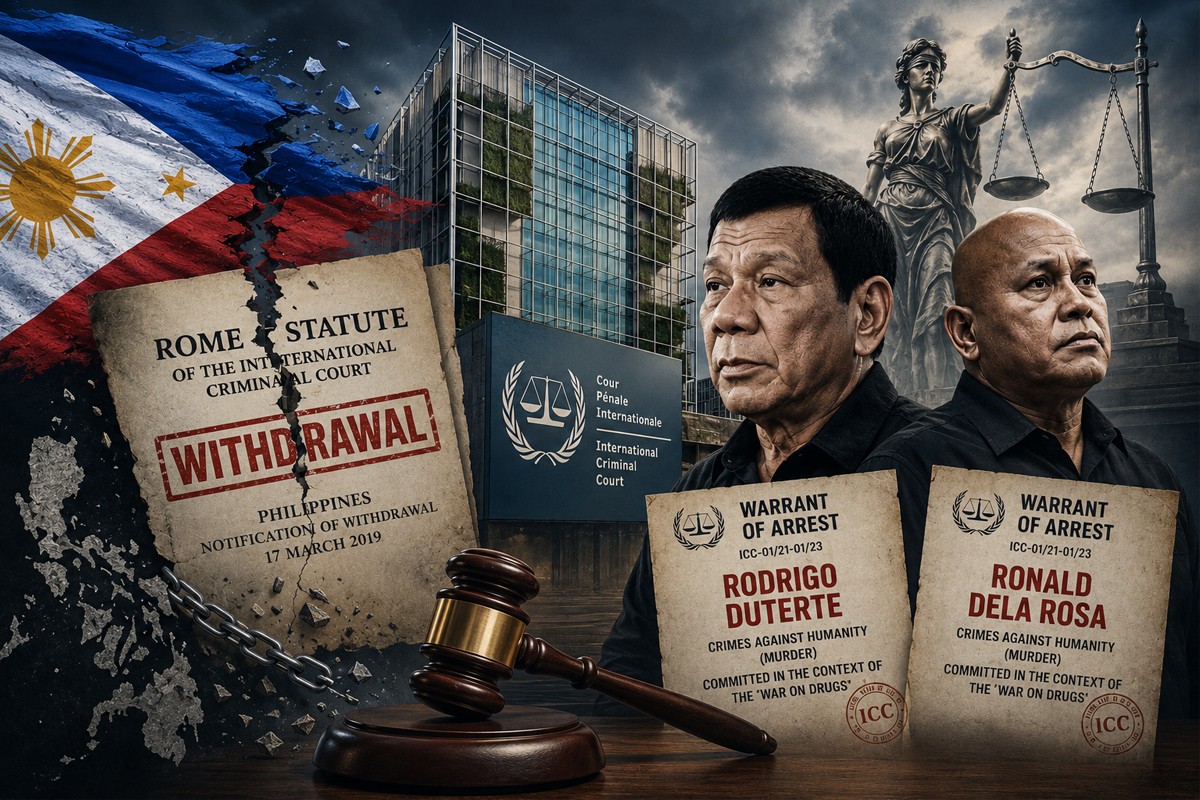
Since Mr. Rodrigo Roa Duterte became the 16th President of the Republic of the Philippines, the Philippines and its relationship with the ICC became more critical up to this point. The controversy started with the iconic Duterte’s aggressive anti-drug campaign widely known as the “War on Drugs”. This campaign drew attention from the international counterparts due to the alleged involvement of the Philippine police force in the vigilante-style and systematic killing of the general public involved in the drug-related crimes. This prompted the ICC’s investigation on the Situation in the Philippines. Consequently, as a response to this, the Philippine Government under the Duterte Administration withdrew from ICC as a state party. This raises major questions about the ICC’s power to investigate the Situation on the Philippines and to subject Duterte and the officials under his command, and later into prosecution over the alleged Crimes against humanity.
These issues became even more heated in 2025 when ICC Pre-Trial Chamber issued of a Warrant of Arrest against former president Duterte. This triggered nationwide debate: “Does the ICC still have authority over the Philippines even after it withdraws as a State Party?”. Moreso, may Filipinos question why the government appeared to cooperate with the ICC despite being a non-state party to the Rome Statute?
The controversy goes deeper as lawyers, politicians, and constitutional law experts offered different interpretations of the law. Others argued that the ICC still had jurisdiction over the crimes against humanity allegedly committed while the Philippines was still a member of the Rome Statute. Critics, on the other hand, insisted that allowing the ICC to intervene undermines Philippine sovereignty and the country’s own justice system.
Recently, public attention intensified following the controversial issuance of Warrant of Arrest of the ICC against sitting Senator Ronald “Bato” Dela Rosa, who was implicated as co-perpetrator alongside former President Rodrigo Duterte. The issue gathered more attention by the highly publicized confrontation that unfolded with the premises of the Senate of the Philippines involving the Senate Office’s Sergeant-At-Arms (OSAA) and the operatives of the National Bureau of Investigation (NBI). Consequently, these series of events fueled the widespread public debates, generating diverse opinions, legal opinions and political discourse from various sectors of the society, all seeking to address and resolve the complex issues surrounding sovereignty, jurisdiction, accountability and rule of law.
Later, with the case of Pangilinan vs. Cayetano, 1 this controversy reached the Supreme Court. Thus, through the penmanship of Honorable Senior Associate Justice M.V.F Leonen, extensively expounded on the constitutional principles and legal implications surrounding the withdrawal of the Philippines from the Rome Statute. The High Court emphasized that before resolving the issue of whether the President may unilaterally withdraw from an international agreement, it is first imperative to determine the nature of the agreement involved. In case of executive agreements, the President is authorized to enter even without the concurrence from the Senate, pursuant to executive’s authority over foreign relations. Meanwhile, when it comes to treaties, Article VII, Section 21 2 of the 1987 Constitution provides for another requirement. Under the Constitution, while the President has the prerogative to enter into international agreement or treaties being the chief architect of foreign policy, concurrence from the Senate is still necessary in order for it to have legal effect.
Stated differently, considering that the Constitution itself requires a legislative concurrence before a treaty to be legally effective, the Court pointed out that the same requirement is necessary in case of withdrawal in a treaty. 3
However, in March 2016, the Philippines submitted its Note Verbale with the United Nations (UN) Secretary General – Chef de Cabinet, signifying its withdrawal from the ICC. Thus, while the Court clarified that legislative concurrence is necessary for the withdrawal from a treaty, Philippines’ withdrawal from the ICC is now irreversible since it is consummated and complete by the UN’s acknowledgement, therefore, making its resolution irrelevant.
On the other hand, while the validity of the Philippines’ withdrawal from the Rome Statute was ultimately upheld, it does not necessarily relieve the Philippines from obligations and responsibilities it incurred while it is a state party to the ICC. Considering that the withdrawal of the Philippines from the ICC only took effect on 17 March 2019, the country continued to be bound by the provisions of the Rome Statute with respect to the acts allegedly committed prior to the effectivity of the withdrawal, particularly those arising from the government’s controversial campaign against illegal drugs. Any alleged atrocities or acts constituting Crimes against Humanity that transpired while the Philippines was still under the jurisdiction of the ICC remain the subject of the ICC’s authority, investigation and prosecution. In other words, subsequent withdrawal from the Rome Statute does not operate retroactively to absolve a State or its officials from its officials from accountability for obligations and liabilities already incurred during the treaty’s effectivity.
The bigger legal question now: “Is the Philippines still required to recognize, enforce or cooperate with the ICC arrest warrants despite already being a non-State Party?”
Considering that the warrants of arrest issued by the ICC arose from events and alleged acts committed during the period when the Philippines was still a State Party to the Rome Statute, it necessarily follows from this premise, that the enforcement and implementation of such warrants must be also governed by the obligations and legal framework existing at that time. In essence, the Philippines cannot evade responsibilities that had already been attached during the effectivity of its membership in the Rome Statute merely by virtue of its subsequent withdrawal from the treaty. The jurisdiction of the ICC, insofar as it pertains to alleged offenses committed prior to the withdrawal’s effectivity, continues to subsist, together with the corresponding duty of cooperation expected from a former State Party with respect to proceedings already initiated or acts already under the Court’s jurisdiction. Hence, consistent with the principles of treaty obligations, international accountability, and good faith compliance under international law, the Philippine Government may be deemed to possess the obligation to recognize, enforce, and implement warrants issued by the ICC in connection with alleged crimes committed while the Philippines remained bound by the Rome Statute.
Under Article 59 4 of the Rome Statute of the ICC, when a State Party receives a request, either for provisional or for arrest and surrender, it shall immediately take steps to arrest the person in question in accordance with its law and the provisions of the Rome Statute. Thereafter, the person arrested shall be promptly brought before a competent judicial authority of the custodial state for determination of propriety of the warrant. 5
In essence, the Philippines maintains its legal obligation with the ICC arising from the period that it is still a State Party and bound by the treaty, notwithstanding its withdrawal. Thus, having the warrants of arrest issued by the ICC born out from these alleged crimes against humanity committed in the Philippines and purportedly committed while Rome Statute was still in force, the Philippines retains a corresponding duty to recognize and give due course to the warrants of arrest issued by the Pre-Trial Chamber of the ICC.
On a final note, while it is indeed true that the Philippines has ceased to be a State Party to the Rome Statute and that the ICC no longer possesses jurisdiction to the Philippines over the acts allegedly committed after the effectivity of its withdrawal, such limitation in jurisdiction cannot, and should not, be selectively invoked merely for purposes of convenience or expediency. The Philippine Government cannot simply rely upon the country’s withdrawal from the ICC as a justification to disregard or evade the proper implementation of warrants issued in relation to acts allegedly committed while the Philippines remained subject to the ICC’s jurisdiction. Correlatively, individuals implicated in the alleged crimes against humanity, committed in the Philippines, cannot simultaneously deny the authority of the ICC while, at the same time, invoking favorable provisions or procedural protections afforded under the Rome Statute. Such inconsistent positions undermine the principles of fairness, accountability, and good faith that underpin both domestic and international legal systems.
Ultimately, these observations are offered only as a humble legal submission intended to contribute to meaningful academic and constitutional discourse on the matter. In any event, the definitive interpretation and resolution of these complex legal questions properly belong to the courts and competent tribunals, whose guidance remains essential in clarifying the extent of the Philippines’ obligations under international law and in promoting the broader interests of justice and society.
Since Mr. Rodrigo Roa Duterte became the 16th President of the Republic of the Philippines, the Philippines and its relationship with the ICC became more critical up to this point. The controversy started with the iconic Duterte’s aggressive anti-drug campaign widely known as the “War on Drugs”. This campaign drew attention from the international counterparts due to the alleged involvement of the Philippine police force in the vigilante-style and systematic killing of the general public involved in the drug-related crimes. This prompted the ICC’s investigation on the Situation in the Philippines. Consequently, as a response to this, the Philippine Government under the Duterte Administration withdrew from ICC as a state party. This raises major questions about the ICC’s power to investigate the Situation on the Philippines and to subject Duterte and the officials under his command, and later into prosecution over the alleged Crimes against humanity.
These issues became even more heated in 2025 when ICC Pre-Trial Chamber issued of a Warrant of Arrest against former president Duterte. This triggered nationwide debate: “Does the ICC still have authority over the Philippines even after it withdraws as a State Party?”. Moreso, may Filipinos question why the government appeared to cooperate with the ICC despite being a non-state party to the Rome Statute?
The controversy goes deeper as lawyers, politicians, and constitutional law experts offered different interpretations of the law. Others argued that the ICC still had jurisdiction over the crimes against humanity allegedly committed while the Philippines was still a member of the Rome Statute. Critics, on the other hand, insisted that allowing the ICC to intervene undermines Philippine sovereignty and the country’s own justice system.
Recently, public attention intensified following the controversial issuance of Warrant of Arrest of the ICC against sitting Senator Ronald “Bato” Dela Rosa, who was implicated as co-perpetrator alongside former President Rodrigo Duterte. The issue gathered more attention by the highly publicized confrontation that unfolded with the premises of the Senate of the Philippines involving the Senate Office’s Sergeant-At-Arms (OSAA) and the operatives of the National Bureau of Investigation (NBI). Consequently, these series of events fueled the widespread public debates, generating diverse opinions, legal opinions and political discourse from various sectors of the society, all seeking to address and resolve the complex issues surrounding sovereignty, jurisdiction, accountability and rule of law.
Later, with the case of Pangilinan vs. Cayetano, 1 this controversy reached the Supreme Court. Thus, through the penmanship of Honorable Senior Associate Justice M.V.F Leonen, extensively expounded on the constitutional principles and legal implications surrounding the withdrawal of the Philippines from the Rome Statute. The High Court emphasized that before resolving the issue of whether the President may unilaterally withdraw from an international agreement, it is first imperative to determine the nature of the agreement involved. In case of executive agreements, the President is authorized to enter even without the concurrence from the Senate, pursuant to executive’s authority over foreign relations. Meanwhile, when it comes to treaties, Article VII, Section 21 2 of the 1987 Constitution provides for another requirement. Under the Constitution, while the President has the prerogative to enter into international agreement or treaties being the chief architect of foreign policy, concurrence from the Senate is still necessary in order for it to have legal effect.
Stated differently, considering that the Constitution itself requires a legislative concurrence before a treaty to be legally effective, the Court pointed out that the same requirement is necessary in case of withdrawal in a treaty. 3
However, in March 2016, the Philippines submitted its Note Verbale with the United Nations (UN) Secretary General – Chef de Cabinet, signifying its withdrawal from the ICC. Thus, while the Court clarified that legislative concurrence is necessary for the withdrawal from a treaty, Philippines’ withdrawal from the ICC is now irreversible since it is consummated and complete by the UN’s acknowledgement, therefore, making its resolution irrelevant.
On the other hand, while the validity of the Philippines’ withdrawal from the Rome Statute was ultimately upheld, it does not necessarily relieve the Philippines from obligations and responsibilities it incurred while it is a state party to the ICC. Considering that the withdrawal of the Philippines from the ICC only took effect on 17 March 2019, the country continued to be bound by the provisions of the Rome Statute with respect to the acts allegedly committed prior to the effectivity of the withdrawal, particularly those arising from the government’s controversial campaign against illegal drugs. Any alleged atrocities or acts constituting Crimes against Humanity that transpired while the Philippines was still under the jurisdiction of the ICC remain the subject of the ICC’s authority, investigation and prosecution. In other words, subsequent withdrawal from the Rome Statute does not operate retroactively to absolve a State or its officials from its officials from accountability for obligations and liabilities already incurred during the treaty’s effectivity.
The bigger legal question now: “Is the Philippines still required to recognize, enforce or cooperate with the ICC arrest warrants despite already being a non-State Party?”
Considering that the warrants of arrest issued by the ICC arose from events and alleged acts committed during the period when the Philippines was still a State Party to the Rome Statute, it necessarily follows from this premise, that the enforcement and implementation of such warrants must be also governed by the obligations and legal framework existing at that time. In essence, the Philippines cannot evade responsibilities that had already been attached during the effectivity of its membership in the Rome Statute merely by virtue of its subsequent withdrawal from the treaty. The jurisdiction of the ICC, insofar as it pertains to alleged offenses committed prior to the withdrawal’s effectivity, continues to subsist, together with the corresponding duty of cooperation expected from a former State Party with respect to proceedings already initiated or acts already under the Court’s jurisdiction. Hence, consistent with the principles of treaty obligations, international accountability, and good faith compliance under international law, the Philippine Government may be deemed to possess the obligation to recognize, enforce, and implement warrants issued by the ICC in connection with alleged crimes committed while the Philippines remained bound by the Rome Statute.
Under Article 59 4 of the Rome Statute of the ICC, when a State Party receives a request, either for provisional or for arrest and surrender, it shall immediately take steps to arrest the person in question in accordance with its law and the provisions of the Rome Statute. Thereafter, the person arrested shall be promptly brought before a competent judicial authority of the custodial state for determination of propriety of the warrant. 5
In essence, the Philippines maintains its legal obligation with the ICC arising from the period that it is still a State Party and bound by the treaty, notwithstanding its withdrawal. Thus, having the warrants of arrest issued by the ICC born out from these alleged crimes against humanity committed in the Philippines and purportedly committed while Rome Statute was still in force, the Philippines retains a corresponding duty to recognize and give due course to the warrants of arrest issued by the Pre-Trial Chamber of the ICC.
On a final note, while it is indeed true that the Philippines has ceased to be a State Party to the Rome Statute and that the ICC no longer possesses jurisdiction to the Philippines over the acts allegedly committed after the effectivity of its withdrawal, such limitation in jurisdiction cannot, and should not, be selectively invoked merely for purposes of convenience or expediency. The Philippine Government cannot simply rely upon the country’s withdrawal from the ICC as a justification to disregard or evade the proper implementation of warrants issued in relation to acts allegedly committed while the Philippines remained subject to the ICC’s jurisdiction. Correlatively, individuals implicated in the alleged crimes against humanity, committed in the Philippines, cannot simultaneously deny the authority of the ICC while, at the same time, invoking favorable provisions or procedural protections afforded under the Rome Statute. Such inconsistent positions undermine the principles of fairness, accountability, and good faith that underpin both domestic and international legal systems.
Ultimately, these observations are offered only as a humble legal submission intended to contribute to meaningful academic and constitutional discourse on the matter. In any event, the definitive interpretation and resolution of these complex legal questions properly belong to the courts and competent tribunals, whose guidance remains essential in clarifying the extent of the Philippines’ obligations under international law and in promoting the broader interests of justice and society.
DISCLAIMER: The views and opinions expressed herein are solely for academic and scholarly discussion and are intended to objectively examine the applicable laws, constitutional provisions, and/or jurisprudence at the time of writing. Furthermore, this article does not constitute legal advice, an official stance on any political matter, or support for any particular politician. Subsequent legal or factual developments may affect the relevance or applicability of the views and opinions expressed herein.
FOOTNOTES
3. Pangilinan vs. Cayetano, G.R. No. 238875, March 16, 202. “Nonetheless,
the President’s discretion on unilaterally withdrawing from any treaty or international agreement is not absolute.
As primary architect of foreign policy, the president enjoys a degree of leeway to withdraw from treaties. However, this leeway cannot go beyond the president’s authority under the Constitution and the laws. In appropriate cases, legislative involvement is imperative. The president cannot unilaterally withdraw from a treaty if there is subsequent legislation which affirms and implements it.
Conversely, a treaty cannot amend a statute. When the president enters into a treaty that is inconsistent with a prior statute, the president may unilaterally withdraw from it, unless the prior statute is amended to be consistent with the treaty. A statute enjoys primacy over a treaty. It is passed by both the House of Representatives and the Senate, and is ultimately signed into law by the president. In contrast, a treaty is negotiated by the president, and legislative participation is limited to Senate concurrence. Thus, there is greater participation by the sovereign’s democratically elected representatives in the enactment of statutes.
The extent of legislative involvement in withdrawing from treaties is further determined by circumstances attendant to how the treaty was entered into or came into effect. Where legislative imprimatur impelled the president’s action to enter into a treaty, a withdrawal cannot be effected without concomitant legislative sanction. Similarly, where the Senate’s concurrence imposes as a condition the same concurrence for withdrawal, the president enjoys no unilateral authority to withdraw, and must then secure Senate concurrence.
Thus, the president can withdraw from a treaty as a matter of policy in keeping with our legal system, if a treaty is unconstitutional or contrary to provisions of an existing prior statute. However, the president may not unilaterally withdraw from a treaty: (a) when the Senate conditionally concurs, such that it requires concurrence also to withdraw; or (b) when the withdrawal itself will be contrary to a statute, or to a legislative authority to negotiate and enter into a treaty, or an existing law which implements a treaty. xxx
All told, the president, as primary architect of foreign policy, negotiates and enters into international agreements. However, the president’s power is not absolute, but is checked by the Constitution, which requires Senate concurrence. Treaty-making is a power lodged in the executive, and is balanced by the legislative branch. The textual configuration of the Constitution hearkens both to the basic separation of powers and to a system of checks and balances. Presidential discretion is recognized, but it is not absolute. While no constitutional mechanism exists on how the Philippines withdraws from an international agreement, the president’s unbridled discretion vis-à-vis treaty abrogation may run counter to the basic prudence underlying the entire system of entry into and domestic operation of treaties.”
As primary architect of foreign policy, the president enjoys a degree of leeway to withdraw from treaties. However, this leeway cannot go beyond the president’s authority under the Constitution and the laws. In appropriate cases, legislative involvement is imperative. The president cannot unilaterally withdraw from a treaty if there is subsequent legislation which affirms and implements it.
Conversely, a treaty cannot amend a statute. When the president enters into a treaty that is inconsistent with a prior statute, the president may unilaterally withdraw from it, unless the prior statute is amended to be consistent with the treaty. A statute enjoys primacy over a treaty. It is passed by both the House of Representatives and the Senate, and is ultimately signed into law by the president. In contrast, a treaty is negotiated by the president, and legislative participation is limited to Senate concurrence. Thus, there is greater participation by the sovereign’s democratically elected representatives in the enactment of statutes.
The extent of legislative involvement in withdrawing from treaties is further determined by circumstances attendant to how the treaty was entered into or came into effect. Where legislative imprimatur impelled the president’s action to enter into a treaty, a withdrawal cannot be effected without concomitant legislative sanction. Similarly, where the Senate’s concurrence imposes as a condition the same concurrence for withdrawal, the president enjoys no unilateral authority to withdraw, and must then secure Senate concurrence.
Thus, the president can withdraw from a treaty as a matter of policy in keeping with our legal system, if a treaty is unconstitutional or contrary to provisions of an existing prior statute. However, the president may not unilaterally withdraw from a treaty: (a) when the Senate conditionally concurs, such that it requires concurrence also to withdraw; or (b) when the withdrawal itself will be contrary to a statute, or to a legislative authority to negotiate and enter into a treaty, or an existing law which implements a treaty. xxx
All told, the president, as primary architect of foreign policy, negotiates and enters into international agreements. However, the president’s power is not absolute, but is checked by the Constitution, which requires Senate concurrence. Treaty-making is a power lodged in the executive, and is balanced by the legislative branch. The textual configuration of the Constitution hearkens both to the basic separation of powers and to a system of checks and balances. Presidential discretion is recognized, but it is not absolute. While no constitutional mechanism exists on how the Philippines withdraws from an international agreement, the president’s unbridled discretion vis-à-vis treaty abrogation may run counter to the basic prudence underlying the entire system of entry into and domestic operation of treaties.”
4. Rome Statute of the International Criminal Court, Article 59. Arrest proceedings in the custodial State 1. A State Party which has received a request for provisional arrest or for arrest and surrender shall immediately take steps to arrest the person in question in accordance with its laws and the provisions of Part 9.
5. xxx 2. A person arrested shall be brought promptly before the competent judicial authority in the custodial State which shall determine, in accordance with the law of that State, that: (a) The warrant applies to that person; (b) The person has been arrested in accordance with the proper process; and (c) The person’s rights have been respected.xxx