From Lifeline to Nightmare: When Online Loans Turn into Tools of Harassment
Carmela Ann Q. Lamsen
Atty. Rhenelle Mae O. Operario
NOVEMBER 2025
It started with a desperate tap.
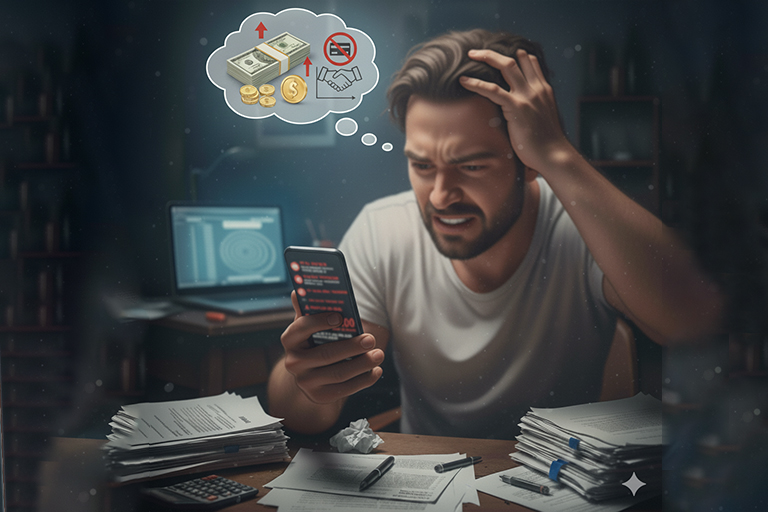
Pam had just received a devastating news. Her father needed an emergency operation, and the hospital demanded an upfront payment she didn’t have. Unemployed and with savings drained, she turned to the one thing she thought could save her family: an instant online loan. Within minutes, her phone buzzed with approval. Relief washed over her….for a moment.
Weeks later, that same phone became a source of anxiety and stress.
When she failed to pay on time, the lending app began sending relentless messages. At first, reminders; then, threats. Strangers started calling her friends and coworkers. One morning, she woke up to find her face, name, and personal details plastered across Facebook, labeled “Scammer.” In an instant, her world fell apart.
Pam’s story isn’t unique. It mirrors the growing number of Filipinos who, in moments of crisis, fall prey to predatory online lending platforms.
In an era dominated by technology and convenience, financial transactions have evolved dramatically.
“Need cash instantly? Get it in just one tap!”
This familiar slogan has become the modern mantra for financial convenience. Thanks to the widespread use of smart phones and constant internet connectivity, securing a loan has never been easier. Gone are the days of long queues and tedious paperworks at traditional banks. A few taps, a quick selfie, and approval often comes within minutes. It is a godsend for anyone facing an emergency.
Online lending applications (OLAs) promise speed, accessibility, and minimal requirements. They cater to those bypassed by traditional banks like freelancers, minimum-wage earners, and the unemployed. Available anytime, anywhere, these apps have revolutionized personal finance.
But behind this digital convenience lies a darker truth where such perceived convenience turns to coercion.
Many OLAs operate with little to no oversight. Borrowers like Pam often grant access to their contacts, photos, or even social media accounts without realizing the consequences. When payments are delayed, these permissions are weaponized.
Borrowers report being bombarded with messages, not only from lenders but also from anonymous accounts sending threats, insults, and doctored images. Some apps allegedly leak borrowers’ personal information online, exposing them to public humiliation.
In 2019 alone, the National Privacy Commission (NPC) received over 400 complaints of online harassment and shaming by digital lenders. Victims reported emotional distress and reputational harm after their data was exploited without consent.1
A Philippine National Police Anti-Cybercrime Group report also revealed that some loan apps included fine print clauses granting them access to clients’ contacts, which later abused for coercive collection tactics. In extreme cases, borrowers even received criminal threats, including rape and murder, linked to loan collectors.2
By mid-2025, complaints had reached alarming levels. Between January and September 2025 alone, the Securities and Exchange Commission (SEC) recorded 3,570 complaints related to unfair debt collection, a staggering rise in the recent years.3
This prompted the government to launch a formal campaign to crack down on rogue and abusive lending apps. The Presidential Anti-Organized Crime Commission (PAOCC) nd SEC began investigating OLAs accused of harassment, fake court orders, and predatory practices.4
On 29 October 2025, the SEC even issued an advisory warning the public against 28 Facebook pages running an “Advance Fee Scam” where victims were tricked into paying deposits in exchange for fake loan approvals, only to be ghosted once the fees were sent. These pages often faked registration documents from the SEC, BSP, BIR, NPC, and DTI to appear legitimate.5
The biggest question now is that, do lenders have the right to harass or threaten the borrowers like Pam due to non-payment?
The short answer is NO.
While lenders have the right to collect debts, they must operate within legal and ethical bounds. Philippine laws clearly prohibit harassment, threats, and public humiliation as debt collection tactics.
It must be emphasized that under the Philippine legal system, there are safeguards that may be availed of by borrowers like Pam.
No less than Section 20, Article III, of the 1987 Philippine Constitution on the Bill of Rights provides that “No person shall be imprisoned for debt or non-payment of a poll tax.6
This means no one can be jailed simply for failing to pay a debt or loan, such as unpaid credit cards, personal loans, or other civil obligations. However, this does not cover cases involving fraud or crimes related to the debt like Estafa and Violation of Batas Pambansa Blg. 22. In those situations, the person may still face criminal liability, not because of the debt itself, but because of the fraudulent act and/or issuance of worthless check.
Republic Act No. 10173 (Data Privacy Act of 2012)7
This law safeguards every borrower’s personal information. Under this Act, lenders may collect and process data only for legitimate purposes like verifying identity or assessing creditworthiness. Using such data for shaming, harassment, or public exposure is a criminal offense, punishable by fines and imprisonment.
To strengthen these protections, the NPC issued Circular No. 20-01 in 2020,8 banning lenders from:
Pam had just received a devastating news. Her father needed an emergency operation, and the hospital demanded an upfront payment she didn’t have. Unemployed and with savings drained, she turned to the one thing she thought could save her family: an instant online loan. Within minutes, her phone buzzed with approval. Relief washed over her….for a moment.
Weeks later, that same phone became a source of anxiety and stress.
When she failed to pay on time, the lending app began sending relentless messages. At first, reminders; then, threats. Strangers started calling her friends and coworkers. One morning, she woke up to find her face, name, and personal details plastered across Facebook, labeled “Scammer.” In an instant, her world fell apart.
Pam’s story isn’t unique. It mirrors the growing number of Filipinos who, in moments of crisis, fall prey to predatory online lending platforms.
In an era dominated by technology and convenience, financial transactions have evolved dramatically.
“Need cash instantly? Get it in just one tap!”
This familiar slogan has become the modern mantra for financial convenience. Thanks to the widespread use of smart phones and constant internet connectivity, securing a loan has never been easier. Gone are the days of long queues and tedious paperworks at traditional banks. A few taps, a quick selfie, and approval often comes within minutes. It is a godsend for anyone facing an emergency.
Online lending applications (OLAs) promise speed, accessibility, and minimal requirements. They cater to those bypassed by traditional banks like freelancers, minimum-wage earners, and the unemployed. Available anytime, anywhere, these apps have revolutionized personal finance.
But behind this digital convenience lies a darker truth where such perceived convenience turns to coercion.
Many OLAs operate with little to no oversight. Borrowers like Pam often grant access to their contacts, photos, or even social media accounts without realizing the consequences. When payments are delayed, these permissions are weaponized.
Borrowers report being bombarded with messages, not only from lenders but also from anonymous accounts sending threats, insults, and doctored images. Some apps allegedly leak borrowers’ personal information online, exposing them to public humiliation.
In 2019 alone, the National Privacy Commission (NPC) received over 400 complaints of online harassment and shaming by digital lenders. Victims reported emotional distress and reputational harm after their data was exploited without consent.1
A Philippine National Police Anti-Cybercrime Group report also revealed that some loan apps included fine print clauses granting them access to clients’ contacts, which later abused for coercive collection tactics. In extreme cases, borrowers even received criminal threats, including rape and murder, linked to loan collectors.2
By mid-2025, complaints had reached alarming levels. Between January and September 2025 alone, the Securities and Exchange Commission (SEC) recorded 3,570 complaints related to unfair debt collection, a staggering rise in the recent years.3
This prompted the government to launch a formal campaign to crack down on rogue and abusive lending apps. The Presidential Anti-Organized Crime Commission (PAOCC) nd SEC began investigating OLAs accused of harassment, fake court orders, and predatory practices.4
On 29 October 2025, the SEC even issued an advisory warning the public against 28 Facebook pages running an “Advance Fee Scam” where victims were tricked into paying deposits in exchange for fake loan approvals, only to be ghosted once the fees were sent. These pages often faked registration documents from the SEC, BSP, BIR, NPC, and DTI to appear legitimate.5
The biggest question now is that, do lenders have the right to harass or threaten the borrowers like Pam due to non-payment?
The short answer is NO.
While lenders have the right to collect debts, they must operate within legal and ethical bounds. Philippine laws clearly prohibit harassment, threats, and public humiliation as debt collection tactics.
It must be emphasized that under the Philippine legal system, there are safeguards that may be availed of by borrowers like Pam.
No less than Section 20, Article III, of the 1987 Philippine Constitution on the Bill of Rights provides that “No person shall be imprisoned for debt or non-payment of a poll tax.6
This means no one can be jailed simply for failing to pay a debt or loan, such as unpaid credit cards, personal loans, or other civil obligations. However, this does not cover cases involving fraud or crimes related to the debt like Estafa and Violation of Batas Pambansa Blg. 22. In those situations, the person may still face criminal liability, not because of the debt itself, but because of the fraudulent act and/or issuance of worthless check.
Republic Act No. 10173 (Data Privacy Act of 2012)7
This law safeguards every borrower’s personal information. Under this Act, lenders may collect and process data only for legitimate purposes like verifying identity or assessing creditworthiness. Using such data for shaming, harassment, or public exposure is a criminal offense, punishable by fines and imprisonment.
To strengthen these protections, the NPC issued Circular No. 20-01 in 2020,8 banning lenders from:
● Accessing a borrower’s contacts, camera, or social media accounts without consent;
● Using personal data to harass or threaten borrowers;
● Retaining borrower data longer than necessary.
● Using personal data to harass or threaten borrowers;
● Retaining borrower data longer than necessary.
Accordingly, violations can result in administrative and criminal penalties.
This is also echoed in SEC Memorandum Circular No. 18, Series of 20199 which specifically prohibits unfair debt collection practices by financing and lending companies including threats, public humiliation, and abusive language. Violators may face sanctions, suspension, or revocation of licenses.
Republic Act No. 10175 (Cybercrime Prevention Act of 2012)10
This law makes it a criminal offense to engage in online libel, cyber harassment, cyberbullying, or any unauthorized access to personal data or computer systems. It also covers threats, intimidation, and defamatory statements made or sent through text messages, emails, social media platforms, or online chats.
Under this Act, individuals who use electronic means to harass, threaten, or publicly humiliate others, including borrowers in debt-collection scenarios, may be held criminally liable. The same applies to persons or entities that illegally access, misuse, or manipulate personal data obtained through digital platforms.
However, despite these numerous regulations, no comprehensive law directly addresses harassment by online lending apps. Recognizing this gap, Senator Win Gatchalian filed Senate Bill No. 818, or the “Fair Debt Collection Practices Act,”11 in April 2025. The bill aims to outlaw all forms of abusive debt collection, including threats, obscene language, and public disclosure of debtors’ identities, ensuring borrowers are treated with dignity.
The digital lending revolution was meant to democratize access to credit, not to weaponize technology against the vulnerable.
For millions like Pam, what began as a lifeline turned into a nightmare of fear and humiliation. Her only mistake was trusting an app that promised to help in her darkest hour.
As the government tightens regulations, the responsibility also falls on users to read, verify, and protect their data before granting access to online lenders. Because in the age of “click, borrow, suffer,” safeguarding one’s privacy is the only way to borrow safely and keep dignity intact.
This is also echoed in SEC Memorandum Circular No. 18, Series of 20199 which specifically prohibits unfair debt collection practices by financing and lending companies including threats, public humiliation, and abusive language. Violators may face sanctions, suspension, or revocation of licenses.
Republic Act No. 10175 (Cybercrime Prevention Act of 2012)10
This law makes it a criminal offense to engage in online libel, cyber harassment, cyberbullying, or any unauthorized access to personal data or computer systems. It also covers threats, intimidation, and defamatory statements made or sent through text messages, emails, social media platforms, or online chats.
Under this Act, individuals who use electronic means to harass, threaten, or publicly humiliate others, including borrowers in debt-collection scenarios, may be held criminally liable. The same applies to persons or entities that illegally access, misuse, or manipulate personal data obtained through digital platforms.
However, despite these numerous regulations, no comprehensive law directly addresses harassment by online lending apps. Recognizing this gap, Senator Win Gatchalian filed Senate Bill No. 818, or the “Fair Debt Collection Practices Act,”11 in April 2025. The bill aims to outlaw all forms of abusive debt collection, including threats, obscene language, and public disclosure of debtors’ identities, ensuring borrowers are treated with dignity.
The digital lending revolution was meant to democratize access to credit, not to weaponize technology against the vulnerable.
For millions like Pam, what began as a lifeline turned into a nightmare of fear and humiliation. Her only mistake was trusting an app that promised to help in her darkest hour.
As the government tightens regulations, the responsibility also falls on users to read, verify, and protect their data before granting access to online lenders. Because in the age of “click, borrow, suffer,” safeguarding one’s privacy is the only way to borrow safely and keep dignity intact.
FOOTNOTES
1. NPC conducts hearings on 48 online lending apps after over 400 harassment complaints – National Privacy Commission
https://privacy.gov.ph/npc-conducts-hearings-on-48-online-lending-apps-after-over-400-harassment-complaints/
2. Online lending app workers nabbed for allegedly harassing clients, contacts https://www.gmanetwork.com/news/money/companies/821763/online-lending-app-workers-nabbed-for-allegedly-harassing-clients-contacts/story/
3. SEC: Over 3,300 complaints received vs unregistered financing entities | GMA News Online https://www.gmanetwork.com/news/topstories/nation/961486/sec-over-3-300-complaints-lodged-vs-unregistered-financing-entities/story/
4. Crackdown on abusive online lending apps launched | Philstar.com https://www.philstar.com/headlines/2025/06/16/2450995/crackdown-abusive-online-lending-apps-launched
7. Republic Act 10173 – Data Privacy Act of 2012 https://privacy.gov.ph/data-privacy-act/
8. NPC Circular No. 20-01 https://privacy.gov.ph/wp-content/uploads/2020/10/NPC-Circular-No.-20-01.pdf
9. SEC Memorandum Circular No. 18 https://lpr.adb.org/sites/default/files/2024-04/philippines-2019-mc-no-18.pdf
11. Press Release – Gatchalian Laments Harassment Perpetrated by Online Lending Companies https://web.senate.gov.ph/press_release/2025/0423_gatchalian1.asp
*The views and opinions expressed are based on applicable laws, constitutional provisions, and/or jurisprudence in force at the time of writing, and do not constitute legal advice or an official stance on any political matter. Subsequent legal or factual developments may affect the relevance or applicability of the views and opinions herein expressed.